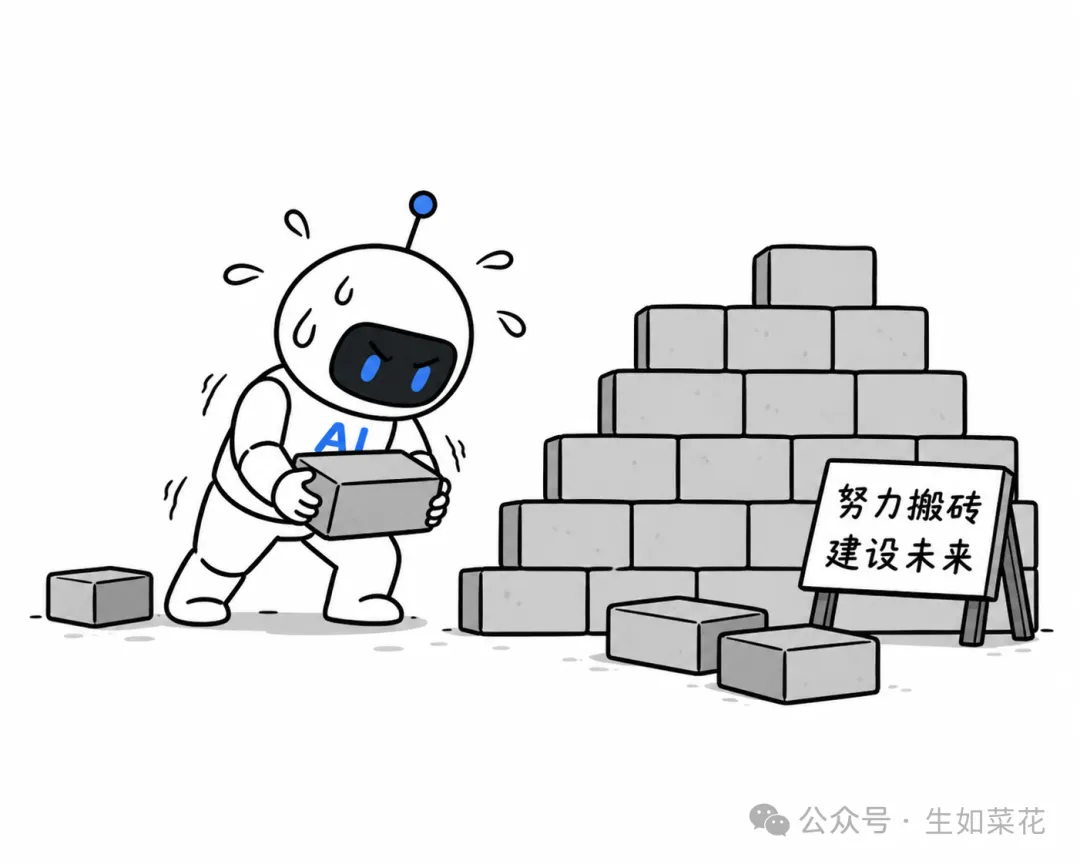
When AI completes 80% of the work, does humanity enter the age of leisure? Or does the era of human replacement officially begin? Will our anxiety become reality? Or is our future more worth anticipating?
In 2026, debating whether "AI will replace humans" has become outdated and tiresome.
The real crisis lies elsewhere: when AI, with its exponentially evolving self-correcting capabilities, silently collapses all execution processes, thinking paths, and even collaboration costs—where do we stand, those of us who once found security in the "busy process"?
Strip away the physical and mental repetitive labor that AI has already mastered, and I see our work landing on several solid "nails."
01
Goal Modeling — You Are Defining the Future
We once worshipped "handiwork," believing that writing good code or creating beautiful designs was the essence of skill. But in the AI era, the execution barrier has fallen to dust.
Today's top-tier capability is "defining what is right." Can you, amidst your boss's vague complaints and market chaos, precisely model that "right outcome"?
AI possesses infinite execution power but lacks direction. If you cannot translate business pain points into battle maps that AI can understand, your so-called "expertise" is worthless before algorithms.
02
Dynamic Arbitration — Reject the "Poison of Mediocrity" Fed by Algorithms
Many celebrate: AI has learned self-correction, even logical error checking!
But don't celebrate too soon. AI's self-correction is probability-based "centripetal force"—it instinctively pulls all your creative sparks toward the most mediocre, most correct average.
The correction we need isn't fixing typos. It's precisely detecting that scent of "soulless mediocrity" in AI's logically perfect solutions. You must dare to arbitrate AI's so-called "correct answers": submit to algorithmic mediocrity, or hold onto that irrational human intuition?
03
Red Line Sovereignty — Security Is the Last Non-Negotiable
Forget grand AI ethics. In practice, security IS "business sovereignty."
When AI chases efficiency frantically, it doesn't care if data crosses boundaries or if your trade secrets become nutrients for model evolution. As "supervisor," you must watch not just output, but red lines.
If you slack here, when AI becomes a "mole" or systems fall into logical loops, what collapses isn't just efficiency—it's your carefully built business foundation.
04
Accountability — Humanity's Last Privilege and Heaviest Chain
This is the cruelest point: AI only outputs content; humans are the ones accountable.
In this chain, AI can never be a legal entity. It won't go to jail for decision errors or jump off buildings for losses. All efficiency dividends must ultimately transform into social credit through one person's signature.
You're not paid for "workload" but for "risk" and "vision." This pressure of "final accountability" is your most solid career moat in the AI era.
In this era, we don't need more brick movers, even digital ones.
If you find your value still attached to "execution" itself, you're one step away from abandonment.
Remember: AI's self-discipline keeps the system from "making mistakes." Your existence keeps the business from "going off track"—and dares to say, when results come out, "This is on me."